Saturday, 23 February 2013

betwixt and between, grand designs, margot style...

For as long as I can remember, and that's quite a long time, I've dreamed of building my own home on Rathlin Island.

One of my most inspiring memories is of baking bread with my granny, in the home where my father was born and raised on the island. Smothered in a dusting of flour and baking soda, my neck stretched and my stance balanced on tip toes so I could lean into the warmth of her embrace, I pronounced for the first time the romantic notion that would become synonymous with my regular musings. When I grow up, I said, I’m going to build a big house beside you and come and look after you.

She died when I was nine so the reality is that I can never look after her, but my heart thumps that little bit harder knowing that she can watch over me, guiding me from a shared presence. Finally, after so many years of saying I was going to do it and never actually doing it, it's happening, a new home, a creation drawn from my heart and soul is being built at Mullindress, Rathlin Island.

Its bricks and mortar are a lifeline, and its beating heart will echo my children's and their children's and so our roots will bind and strengthen and our narrative will grow, our family continuing to build on the solid foundations of past generations who have paved the way for us. My lovely siblings, parents and nephews, nieces and great nephews, will join us in warming ourselves in front of the big old open fire where we can share our past and create a future built on new possibilities.

For those of you unfamiliar with the island Rathlin, the island, just off the north east coast of Ireland, is at the centre of everything. Here's a wee blurb from the Rathlin community website as a way of providing some Kevin MacLeod style background information.

"The island has County Antrim to the south, the Inishowen peninsula in County Donegal to the west, the island of Islay in the Hebrides to the north, and the Mull of Kintyre in mainland Scotland to the east."

As I mentioned, my father was born on the Island, on Mount Grand, and he grew up there with his four siblings. As children we visited regularly, my mother, although from Scotland, as rooted in the island as my dad and guiding us to love and share its warmth, spending summers in a big old house jam packed with people and history and, with electricity not reaching the island until 1992, no power. As a result, candles and ghost stories were the fabric of our exciting self created adventures.

My uncle still lives in that same home, its bright light standing proudly on Mount Grand, the house watching over Mullindress, a small townland within the protective arms of my father's birthplace. Dad's godfather lived in Mullindress, and when the family left, sadly heading for the mainland due to personal circumstances, my grandfather took over the farm, a hub of back-breaking hard work that he and my uncle nurtured and strengthened. (I am creating a momument to their farming heritage in the garden, a legacy of breathtaking beauty, but more of that on another occassion...)

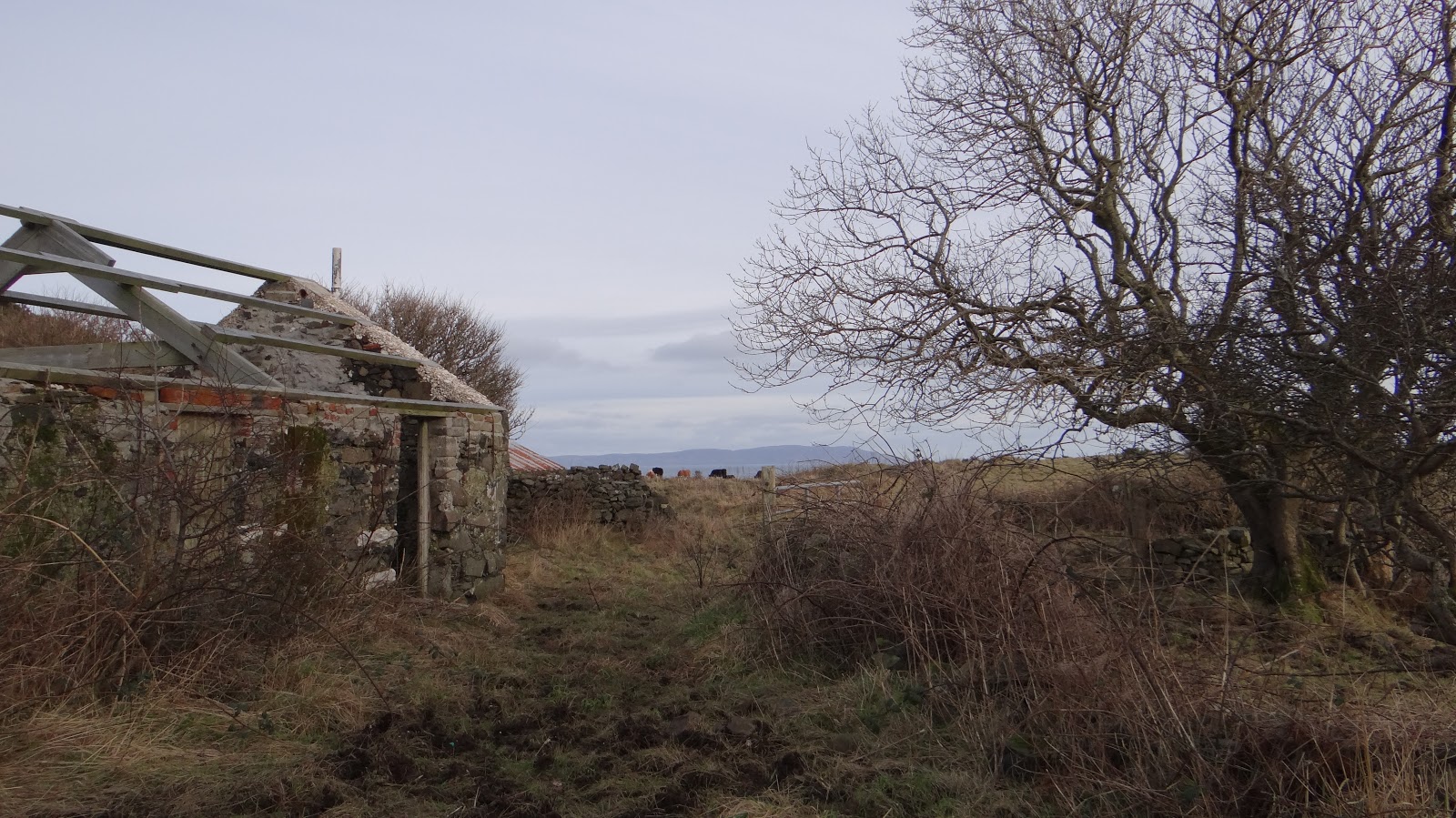
At Mullindress, the home where Joseph, and Sarah and Molly lived and entertained with their tales and ceilidhs and little clay pipes, the story continues. The old dwelling will become my home and the picture below is me standing on the shoulders of the house, more than fifty years on from the final goodbye of its previous tenants.


Mullindress means the view of the two headlands, to the south there is the north coast of Ireland, and to the east, the Mull of Kintrye in Scotland. Here are my headland views! First Ireland, and secondly, the east, and Scotland.

As a child of an Irish father and a Scottish mother, it is betwixt and between, just like me.


So, sentimental stuff out of the way, here's what's happening. With a lot of graft (building in another country, on a remote island, up a hill accessed by a single track lane isn't altogether easy, but who wants easy, right?) the dwelling above will soon look like this...well, actually, that would spoil the surprise, you'll just have to wait and see!!

For the moment though, it looks like this!


Farewell, Mullindress dwelling, hello brave new world. I salute your welcome and your passion. I'm all yours, furnishing your narrative and sharing your journey. I hope you'll join me too.

Next week, the founds!

Sunday, 13 January 2013

"if women were meant to play football they'd have their tits somewhere else"..


This week, Maria Miller MP, Secretary of State for Culture, Media and Sport and Minister for Women and Equalities called for a summit with representatives from Government, broadcasting and the media to discuss ways to encourage a more equitable representation of women’s sport in broadcast and print. This follows the BBC’s Director of Sport Barbara Slater’s announcement that women’s sport is to be given a stronger portfolio across the BBC networks.

Channels like BBC ALBA in Scotland has shown a commitment to women’s football since its inception so it’s refreshing to see the more established channels following suit, even if the cynic could argue the door is only opening because the escalating cost of broadcasting rights has resulted in the more popular mainstream sports becoming somewhat untouchable to anyone other than the cash rich sports channels operating in a harsh and competitive non-terrestrial commercial market.

That said, it’s a door and if it is creaking open slowly then we should give it an almighty push to help it along. It's long overdue. Less than 5% of sports media coverage in the UK is dedicated to women’s sport. This is astonishing, particularly given participation levels among women, and the primary place sport in general commands on television and in print. Dedicated sports channels and newspaper sections are as much an integral element of society as going to school, although one marked difference is that academic education caters for girls and boys.

So, is this an exciting new dawn for women’s sport, particularly women’s football which is witnessing a surge in popularity thanks to a hugely successful Olympics and the BBC's securing of live rights of the 2013 UEFA European Championships?

Let's go back to the 1980s and look at how representation of women's football in the media has changed. Or more specifically, why it still needs to dramatically change.

Sport isn't immune to politics, neither is it divorced from reality. Football and how it has been represented as a social entity has undoubtedly played a role in driving popular consciousnesses and accepted definitions of ideologies in the way in which it frequently influences the reproduction of masculine standards and notions of stereotypical definitions of femininity.

Film writers have utilised the narrative texts of sports language to explore the wide arena of political issues indicating the dynamism and influence that sport has had, and continues to hold in shaping the very fabric of society.

Take Bill Forsyth's ‘Gregory's Girl’ for example.

The deconstruction of ‘Gregory's Girl’ demonstrates that the narrative of film can be deduced as a rich resource of intelligible material that reflects reality. The film teases, challenges and yet still succeeds in defining a concept of modernity in society by promoting a comprehensive insight into the extent to which masculinities were both established and destabilised in society. With the threat to the main protagonist's masculinity at the core of the film we can draw on a period of fluctuating change and uncertainty in society and challenge the relations of difference from a position of playful yet poignant reflective irony. The ongoing irony, ironically being, that despite the film being a big hit of the 1980s perceptions haven't changed, hence the need for a political summit to address the reasons why women are not equally represented in sport in the media.

‘Gregory's Girl’ provides an example of the possibility of disruption and resistance within and to dominant sports' structures. The subordinate definition of the female role is challenged when a woman enters an arena traditionally categorised as one that reflects men's collective domination over women.

Dorothy, the female lead in the film, shock horror, plays football.

The underlying connotation for Gregory is that he has forfeited his football, his bastion of male preserve, in favour of love in this ambiguous world of modernity, where the inclusion of women with the ultimate bonding of male teammates is possible. The film's writer, Bill Forsyth, teases us with the notion that women in football is only acceptable when there is personal gain to be had. For Gregory it's the hope of a girlfriend; for Andy it's to get one over on Gregory who stole his place in the team and for the coach; prestige from his colleagues who think he is the laughing stock of the school.

When confronted with Dorothy in the team, Andy's reaction changes from a form of numbness to anger, then finally to an acceptance of Dorothy on the basis that she can play football.

However, on first watching Dorothy play Andy comments 'if women were meant to play football they'd have their tits somewhere else. How else can you stop a ball and trap it on your chest with big tits banging around? They weren't designed for football.'

It’s worth noting that women in 21st century football aren’t fighting to be men, they don’t have aspirations to play in male teams. The modern day Dorothy just wants an equal playing field for her sport. She wants, and deserves, recognition for her talent, and an equitable place in the dissemination of sports related news and coverage in the media. Not everyone likes every sport but that doesn’t stop a plethora being covered in the media already.

Whilst Andy in ‘Gregory's Girl’ alters his perceptions and comes to call for more girls in the team, there are still far too many 'Andy's' of the "tits" comments in today's society.

At the time of the ‘Gregory's Girl’ film in 1980, 70% of sports programming broadcast in the UK featured no women's sport, and astonishingly, by 1989/90, 81% of programming was without reference to women. With that figure escalating to a somewhat incredible 95% in 2013, (95%!!) that summit really can’t come quickly enough.

Monday, 17 December 2012

christmas capra, film and firearm crime

It’s the crazy season, the one where we all embrace tradition with an affliction of heartfelt fondness and encourage one another to hug family and friends with the intensity that a year of neglect can demand.  And all the while we are engaging in social gatherings and relaxing into pastimes that allow us to assume an imagined life that provides us with the opportunity to question the people we have become and afford us a wee chance, should we choose to accept it, to do something different.

We curl up with our children, our friends or our lovers, and our books and DVDs and life is actually different, and for a little while at least, meaningful and significant. Increasingly, one of the tools we use to capture that sense of worth is by watching poignant films, movies with a tell-tell message. 

Screenings of old black and white movies, like Frank Capra’s It’s A Wonderful Life, are sold out in cinemas and in a unified emotional slumber we engage in an uplifting, inspirational experience that teaches us (with more than a little finger wagging!) that to be good is to be right and clever and kind.

But what of the broader meaning of these old films, especially in the period of their actual place in time?

In 1930 America, of a population of 120 million, 100 million made a weekly visit to the movies (60 million went to Church on a weekly basis...). Some of the most popular films were those of the man  mentioned, Italian immigrant Frank Capra whose movies frequently represented the sub-text of his own life, the achievement and consequence of realising and living ‘The American Dream’.

Capra’s journey from poor immigrant to national figure, through sheer determination and hard work, overcoming significant hardship along the way was text book material, symbolic of the ethos of American society, and as such fuelled an interest in his character and his films. Capra and his language represented the aspired ‘real’ world, which for most had only ever been imagined. The vocabulary of Capra’s movies demonstrated an overwhelming command of film and common language that depicted America as its people held it to be. For the American population his films resolutely asserted a number of familiar elements that were representative of the American way of life whether by actuality or perhaps more tellingly, by aspiration.

Remarkably, Capra’s movies extend even further beyond that. His movies are useful, especially now, in helping us to gain an understanding of the cultural history of America. If you are watching this Christmas, you will be able to see how as the narrative cleverly unfolds onscreen.
Capra, often referred to as a utopian populist, offered a fairytale alternative to the grim reality of the Depression whilst at the same time providing a grounding of a familiar world, reaffirming experiences culturally reflected and understood from the inside out by his audiences.  Capra has been quoted as being ‘the most insistently American of all directors’ – that is, he was obsessively concerned with scrutinizing American myths and American states of consciousness. In undertaking an in-depth examination of the language of Capra, as expressed via the figurative technique of his characters and storylines which respond to issues of gender, repression, politics, idealism and nationalism, a unique insight into how the population lived, or perceived to live their lives, in 1930s cultural American society is represented and revealed.
Capra explores a number of constituents of American cultural life through his use of idiosyncratic language and in doing so he creates characters, in the period they reflected, that are successful in providing upbeat entertainment which the Depression audiences were anxiously looking for. This shift towards unity and individual success is a recurring theme in Capra’s work and represents yet another element of this constant commitment to fulfilling, for his audience, the ‘American Dream’. 

In Mr Deeds Goes to Town, in the language and character of Deeds, Capra engages his audience in his attempt to reflect American society by creating a dramatic social circumstance that forces his character to speak symbolically, not just for himself, but for all Americans afflicted by the power of the institution over the weak.

For Capra the association between the metaphorical character and reality of life was evident in his analogy that each of his characters ‘are human and do the things human beings do – or would do if they had the courage and opportunity.’ His use of family values, a location for the populace to embody a fundamental and valuable feature of American culture, makes his audience comfortable with the material. This wasn’t particularly representative of the way in which Americans lived their lives but it is certainly systematic of the way in which, via the aptitude of the ‘American Dream’, they have been shaped to understand their lives. In embodying this technique the audience is at home with the analogy generated by the film’s methodology.
The audience now, here in the UK too, engages in Capra films like It’s A Wonderful Life in a similar way. The reaction of us, its 21st century audience, and our willingness to accept the story is symbolic of our understanding of the message which reflects a familiar or aspired pattern of life. The reaction and interaction with the plot and its story is demonstrated in two strands, fantasy or reality.
Regardless of which, the language is successful in constructing an equitable representation of the cultural desires, nuances and understanding of its audience. We want to be somewhere else and for some that desire to escape is entirely understandable.
Capra reaffirms that the dream is permissible, but only if the good challenge the bad and the political tyrants are succumbed by the power of collective justice.

In the wake of the unthinkable violence in Newtown, collective justice is all the people of America have if they are to break the cycle of firearm atrocity.
If you’re escaping this Christmas, think about the different ways in which you can come to understand that escape, and remember that collective justice is the route to a reality that at the moment only looks as if it can be imagined.


Sunday, 2 December 2012

'all there is for now', gaelic and telling stories


I'm going to start with the last first.

Telling stories is integral to everything that I engage in personally and professionally, whether it is in conversation, making television, articulating an idea, writing a creative proposal or indulging in writing my own fiction.

And yet people don't really do it any more, not in the traditional sense of huddling around the fire and making elaborate conversation into the wee small hours with a wee story that is as embellished as the day is long.

I feel very blessed to have grown up, and into, an environment where talking was king, be it about football or ghost stories or the good old days of the past, my childhood was often spent amidst adult conversation, lost in endearing and often raucous chat that was the principal source of our evening's entertainment.

It makes my heart heavy when I watch people's eyes roll and sink at the prospect of listening attentively as an older person recounts a narrative which has connotations of some personal importance. It is often part of who they are; its arc the residue of everything that has constituted their very being. Yes, in traditional storytelling it is often exaggerated and its truth diminished as it is adapted to suit its audience, but it makes my heart jump with joy to watch a narrator pass on a skill that quite tantalisingly allows us to grow and develop and push on with some aplomb because we know how to structure a story arc and deliver a beginning, a middle and sometimes even an end.

Everyone should take a minute, or an hour, or even an evening when they get the chance and embrace a story delivered from the heart. It strengthens families and communities and explodes in time in the form of a burst of creativity in others, and goodness me where on earth would we be without that.

Like storytelling language is important, in its vernacular and in its various colloquialisms that allow people to engage with one another in words that build bridges and promote a kindred spirit of shared experience and togetherness. But we don't have to be part of the 'gang' to embrace language and culture that isn't deemed as our ‘own’.

I read with some disappointment recently a comment accusing an agency of "ghettoising" something because it was going to be delivered in the Gaelic language. It's an incredibly naive assessment to make. Gaelic is a beautiful language and it is available to everyone to enjoy. The language is expressive and poetic and hugely integral to the art of storytelling.

The fact that Gaelic is being showcased on its own channel on television and delivered in artistic ways means it is incredibly easy for a viewer to access, engage and should they so wish, understand the language. It is genius. Take football or rugby for example...

In this medium Gaelic can be celebrated and, for those with a desire to learn, comprehended. Watching football, a big rectangle space with familiar words and phrases repeated in easily identifiable areas of the 'painting by numbers' pitch is just lovely. How lucky are we to be able to pull two creative things together - football and Scotland's national language - and present it in an engaging and entertaining way.

I'm not a Gael but I'm embracing the language because it's bold and it's creative and its part and parcel of Scotland's heritage. I'm not fluent, I understand a wee bit, and sometimes to my amusement I find myself using Gaelic words in my head instead of the English equivalent. It's lovely. You can love it too. Come and join the Ceilidh. There’s a nice introduction to using the language on the Learn Gaelic website.

I'm writing a new novel, 'all there is for now' and wee tiny snippet - a whole 75 words - was published by paragraph planet recently. It's a creative website that publishes short fiction of exactly 75 words. It's not as easy as it sounds. Give it a try.


Saturday, 1 December 2012

the next big thing...


"The Next Big Thing, authors tagged, questions answered..."

Does the concept sound pompous, slightly up itself perhaps? Well it's not at all; it's a thing of real beauty, a chain that brings together wonderful writers and books in a circle of creativity that is so vibrant it creaks in celebration.

The very lovely Elizabeth Reeder tagged me and in turn I'm going to answer the questions posed and introduce you to some incredibly strong writers who are dedicated to storytelling.

 Here goes!

What is the working title of your next book?

The Dandelion Clock

Where did the idea come from for the book?

When my children were very young they called themselves Mary and Joseph, because as they explained, the Virgin Mary (yeah, that one...) would call in and see them during the night. It got me thinking, in religion people believe the most incredible things with absolute conviction so why not take it a stage further and illustrate that the VM can pop down from heaven and get herself into a bit of an emotional tangle. She was also a good tool to use to illustrate some of Elizabeth's pain. It is Elizabeth’s story and she comes from all of us.

What genre does your book fall under?

Literary fiction

What actors would you choose to play the part of your characters in a movie rendition?

Oh good question. I would love Shirley Manson to play the Virgin Mary, Kathleen McDermott to play Elizabeth and Sadie would have to be a young and very brash Tilda Swinton. There's a couple of very mean boys in my novel, but I would hate to tarnish anyone's reputation by suggesting that they would fit the part...

What is the one sentence synopsis of your book?

When teenage mum Elizabeth is plotting to avenge her girlfriend's death she becomes mixed up in drugs, murder and hard-assed Glasgow gangsters, as well as becoming entangled with the (actual...)Virgin Mary who comes to question her own life and her feelings for Elizabeth.

It's 'aw go as they say.

Will your book be self-published or represented by an agency?

Hopefully published and represented, fingers crossed on that one at the moment...
How long did it take you to write the first draft of the manuscript?

Well, there's a wee story to that. If we ignore the fact that The Dandelion Clock emerged from the roots of another novel then I would say around 12 months. If we add in the previous work, which has mostly been consigned to the dustbin, then it's a lot, lot, longer.

What other books would you compare this story to within your genre?

This is a difficult question to answer but maybe for the language, the raw humour and the stark bite of reality something Des Dillon or Irvine Welsh.

Who or what inspired you to write this book?

The need to write a story that narrates Elizabeth's journey. Her road is a road so many travel along. Life is actually like that and we should embrace it and give not always getting it right a voice. It’s okay not to be brilliant. Normal is good.

What else about your book might pique the reader’s interest?

It's a story that challenges how we respond to the choices we make, or have made by others for us, and it represents the notion that there isn't a big 'we shall overcome' agenda in life, it's about getting on with it and constantly picking up pieces and slicing up and over the next bit. The story is sad and that's sad because there is always sadness of some degree in a person's life. But there are tiny snippets of hope too and they don't have to be 'happy ever after' paths, they're just there to embrace for the moment and that's the kind of thing that makes life what it is.

This is a story for so many people. It will make you laugh and maybe make you cry too. Key emotions that make us strong and convincing and remind us who we are. It's for you all really.


Wednesday, 24 October 2012

passion is at the root of determination


It is with a heavy heart that I begin to write this.

And yet I know with unwavering conviction that as the words slowly unfold on this page, each tiny letter collaborating with another and gaining ascendancy over the last, gently encouraging the next expanding word, that their strength will grow and so too will my determination.

It has been an evening of contrasting emotions - elation, trepidation, triumphalism, anxiety, joy and then utter, utter sadness. As dusk collapsed into darkness an inspiring movement, a thing of absolute beauty took to the heights with aplomb, riding the horse latitude with confidence only to stutter and stagnate in the face of the doldrums.

 A new beginning was within touching distance for the Scotland's women's national football team. So agonisingly close. And then the trade winds of Spain reversed and cooled and blew defiantly in the opposition's favour.

We crashed to the earth alongside them, not as a nation of people from Scotland but as a union of women, breathing as one, willing the empowerment of one another, collapsing deftly to the ground in unison. Fortunately, we fell on solid ground. It can take our weight and we can stretch our wings and fly again.

With passion there comes determination and a will to push disappointment to the side and battle on. In women's football the players and coaches have next to no financial support and resources, the girls endure scathing attacks on the game as a craft, on their personal skill and capabilities as footballers and as if that’s not enough they have to listen to the ridiculously boring and unfortunately enduring notion that they are women trying to be men.

That inaccurate picture clouds the real vision. In women’s football there is talent and passion in abundance. It is an enviable mix. So much so, that this potent combination led to the banning of the women’s game in the UK in 1921. Excuses were unfurled but the message was simple, with crowds of tens of thousands attending women’s matches the position of men in society was being challenged. Instead of embracing something strong and admirable they chose to try and destroy it. Bizarrely, given the game’s success how the authorities couldn’t envisage the defiance that followed is a mystery.

It's a cliché, an overused boring anecdote that football is more than a game, but when it comes to the women's game it is exactly that. It's a drive to succeed, a commitment to achieve and a will to challenge the world to wake up to itself and its outdated idiosyncrasies and inadequacies and make space for the girls.

Women have been playing football for at least as long as men, from as far back as the 1700s in Scotland. In the 19th century, Lady Florence Dixie, a curious and extraordinary Scot with a desire to make the world an equal place for women, formed a women's football team, its objective to use the sport as a means to create opportunities for women in a tense Victorian society soldered together with gender bias and gross unfairness and inequality. With her captain, the aptly named Nettie Honeyball in tow, Lady Florence’s team, comprised of middle class 'ladies' began a campaign that continues, albeit on a different platform with a different agenda, to this day. A diverse agenda, but the similarities are there. It is still about empowerment.

Anna Signeul’s Scotland team, and the Glasgow City FC’s of this country, aren’t openly brandishing banners depicting their call for equal rights but their determination to create equal opportunities are just as blatant and exciting. The understanding of what the women’s game is and what it is quite spectacularly trying to achieve, is becoming clearer thanks to their commitment.

Women aren't trying to be men; that notion has gone beyond laughable. It’s just downright annoying. They are playing women's football, with WOMEN being the operative word. They are strong, independent individuals who collectively epitomise the fight for a new beginning. They may have been grounded for now but this is their game, and our resolve carried by their skill, talent and knowledge will generate the passion and determination to allow us all to continue to grow.

There isn’t just a tomorrow, there is also a today. The struggle continues. And my goodness, isn't it just fabulous to watch.

Sunday, 23 September 2012

the tree of love


Next weekend I'll be here, positioning myself and my family in the gentle shadow of this beautiful old tree, embracing its energy and paying homage to its narrative.
 
The tree's roots plough into the rich history of the land that they sustain, strong limbs stretching with unrivalled intention into warm soil, long fingers channelling backwards and forwards in peaty earth that tastes of cold autumn evenings. The scent of a slow burning fire hangs softly in sharp air that charts the space you breathe, coming alive in a frosty smoke that chases speech playfully, meandering suggestively among tickling branches before taking flight. If its roots were underwater they would fashion a creel; a conduit of hope.
 
This Muile nan Craobh (Mull of the Trees) in the townland of Mullindress, Rathlin Island, is my garden of Eden, the field in which my new home is rising from the hallowed earth, emerging from soil that has enriched and blessed my father's family, my siblings and my children's. It is an integral element of who we all are and what we will all become. Its past is our past, its future our legacy. It is fitting then that this strong symbol of life, so important to us in fortifying our heritage and giving optimism for the future, will be Tommy's tree.
 
Next weekend, my beautiful Grandson Tommy will secure his rightful place in the inheritance that is rightfully his, even though it was wrongfully denied him. As we remember him, imagining with joy and sadness the world that we dared to hope to embrace alongside him, his roots will cradle us, protect us and keep us safe. We will never forget him and in the Muile nan Craobh he will be as much a part of us as we are of him.
 
Tommy’s narrative is embedded in the roots of Mullindress and our American oak swing, hand carved with love and compassion and swung high from the arms of strong branches, will sway with him and hug and protect his memory.